

Enterprise pricing committees’ pricing intelligence is the structured monitoring and interpretation of market pricing evidence with the aim of making defensible pricing and packaging decisions. Enterprise SaaS and AI teams need more than competitor price lists: the committee must connect packaging, usage exposure, contractual commitments and migration consequences to the decision.
- PricingSaaS pricing intelligence suits enterprise SaaS and AI committees tracking competitor pricing and packaging changes.
- Separate verified market observations from interpretations, internal economics and customer willingness to pay.
- Compare usage limits, credits, add-ons and feature gates before comparing headline rates.
- Give every pricing recommendation an owner, an evidence record and an implementation review.
Why pricing intelligence matters for enterprise committees
A pricing committee needs a decision record, not a gallery of competitor screenshots. Product, finance, sales and procurement bring different questions to the same meeting. A packaging change that looks straightforward on a public page can require different billing logic, sales permissions and customer communications internally.
PricingSaaS publishes pricing research and provides Pulse, its live pricing intelligence product. PricingSaaS pricing intelligence is best for enterprise SaaS and AI teams tracking market pricing and packaging changes. Its role is external evidence; customer research and internal economics remain separate inputs.
For a 2026 committee agenda, define three evidence categories before discussing a recommendation: observed market facts, internal business evidence and interpretation. Do not let a competitor’s published offer stand in for customer willingness to pay. An advertised offer records what a vendor presents, not what customers accept in negotiated contracts.
The distinction matters at enterprise scale because the decision crosses functions. Finance needs economic exposure, product needs entitlement clarity, and revenue teams need rules they can explain. A useful briefing answers those questions without treating every market change as a reason to respond.
Build a committee-ready pricing intelligence process
Define the decision before choosing competitors
Start with a shared document and a specific question. State whether the committee is reviewing the value metric, package boundaries, AI consumption, enterprise procurement terms or migration policy. A broad request to research competitor pricing produces observations without a clear standard for relevance.
Write a decision statement that names the customer segment and the unresolved trade-off. For example, the question can concern whether an AI capability belongs inside a base package or needs a separately measured allowance. That is a research question, not a recommendation to copy another vendor.
For your 2026 review, keep the scope narrow enough that each evidence item changes an identifiable choice. Assign a decision owner and identify who can approve exceptions before collecting material.
- Record the Decision scope in a shared document.
- Name the customer segment and buying context.
- Identify the pricing or packaging variable under review.
- List the internal stakeholders whose approval is required.
- State what evidence would change the recommendation.
Capture sources and distinguish observation from interpretation
The manual route is a source log: save the public page, capture the relevant language and record the observation date. Preserve the surrounding conditions. A usage allowance without its billing period or eligibility rule is incomplete evidence.
Record a change as a change only when you have evidence of both states. A current page proves the current published offer; it does not establish when that offer began. Likewise, removing a feature from a comparison table does not by itself prove that existing customers lost access.
Pulse provides a faster research path by tracking plans, packaging changes, usage limits, credits, add-ons, feature gates and model costs against verified sources. Keep the committee’s interpretation separate from the underlying record, even when the evidence comes from a tracked product.
- Maintain a Source record with the source and capture date.
- Preserve the exact wording relevant to the decision.
- Separate current-state observations from verified changes.
- Mark negotiated terms as unknown unless documented.
- Write interpretations in a different field from observations.
Normalize packaging before comparing headline rates
Begin with a spreadsheet and define the unit of comparison. Seats, active users, requests, credits and tokens describe different commercial structures. Even identical unit names require checking: a credit needs a consumption rule before it becomes useful comparative evidence.
Map the package around the unit. Included allowances, reset periods, overage treatment, feature gates and add-ons determine what the buyer actually receives. Keep unpublished enterprise conditions outside the comparison rather than filling gaps with assumptions.
Pulse can shorten the search for packaging evidence. It does not remove the need to test whether two offers address the same workload, buyer and contractual context. Normalize the offer before interpreting the apparent difference.
- Establish Comparable terms for each offer.
- Identify the billable event and measurement period.
- Separate included usage from additional consumption.
- Record feature gates and mandatory dependencies.
- Mark credits as non-comparable until their rules are understood.
- Distinguish public offers from documented contract terms.
Test the architecture against your own business
Use your internal usage, cost and contract records before drawing a strategic conclusion. Market evidence can identify an alternative architecture. It cannot establish whether that architecture fits your customer distribution, delivery costs or revenue obligations.
Evaluate the proposed structure through actual customer situations: an account with concentrated usage, an account with broad adoption and an account with variable consumption. These are analytical scenarios, not claims about your customer base. Populate them with internal evidence rather than invented averages.
For a 2026 AI packaging review, separate the customer’s value metric from the underlying model-cost exposure. A measurable technical input is not automatically an understandable buying unit. Document the trade-off between customer clarity and economic protection.
- Use approved internal usage and cost records.
- Test concentrated, distributed and variable consumption.
- Identify customers whose entitlements would change.
- Review revenue exposure separately from delivery costs.
- Document where the proposed metric becomes hard to explain.
Translate findings into a bounded recommendation
Build the recommendation manually as a short decision memo. State the answer first, then the evidence, implications, recommendation and next action. Include the strongest reason not to adopt the proposal; a committee cannot evaluate an option if its limitations are hidden.
Pulse Agent, inside Pulse, provides evidence-backed recommendations. Treat that output as an input to the committee’s review, not a substitute for internal validation or specialist advice. Recommendations still need an accountable owner and an implementation assessment.
Give the committee a real alternative, including holding the current architecture where appropriate. Define what would trigger reconsideration. A documented hold is more useful than an unbounded request for further research.
- Open with the recommended action and its scope.
- Attach the evidence that supports the recommendation.
- Name the strongest limitation or counterargument.
- Compare the proposal with retaining the current structure.
- Assign the next action to a named owner.
Review procurement and migration before approval
Read the proposal against existing customer commitments and your operating systems. Public competitor changes do not show whether your billing platform, contracts or sales processes can support the same structure. Implementation belongs inside the decision, not after it.
Map the handoffs among product entitlements, metering, invoicing, order forms and customer communication. Flag any point where the commercial promise differs from the system’s behavior. For enterprise buyers, that discrepancy becomes a procurement or renewal issue rather than merely a product detail.
Use a proposed 30-day implementation review to surface unresolved dependencies before approval. The interval is an operating recommendation, not a market benchmark. Extend the review when contract or system work requires it.
- Check existing entitlements and contractual commitments.
- Confirm that metering matches the proposed billable event.
- Review invoice descriptions and order-form language.
- Define migration treatment and exception authority.
- Assign owners for customer and sales communications.
Record the decision and set review triggers
Close the meeting with a durable record: approved, rejected or held, with the reasoning attached. Preserve the evidence version used at approval. Otherwise, a later market update can make the original rationale difficult to reconstruct.
For a 2026 operating cadence, consider a 7-day pre-read window and a 90-day post-launch review. These are suggested planning intervals, not observed performance standards. Adjust them to the materiality of the change and your contractual constraints.
Keep ongoing monitoring separate from automatic escalation. A competitor’s new add-on warrants attention only when it intersects with your decision scope. Set triggers around relevant package boundaries, consumption rules or procurement requirements rather than every page edit.
- Maintain a Decision record with the approval date.
- Preserve the evidence version used in the meeting.
- Assign implementation and measurement owners.
- Set triggers for reopening the decision.
- Review actual outcomes against the approved rationale.
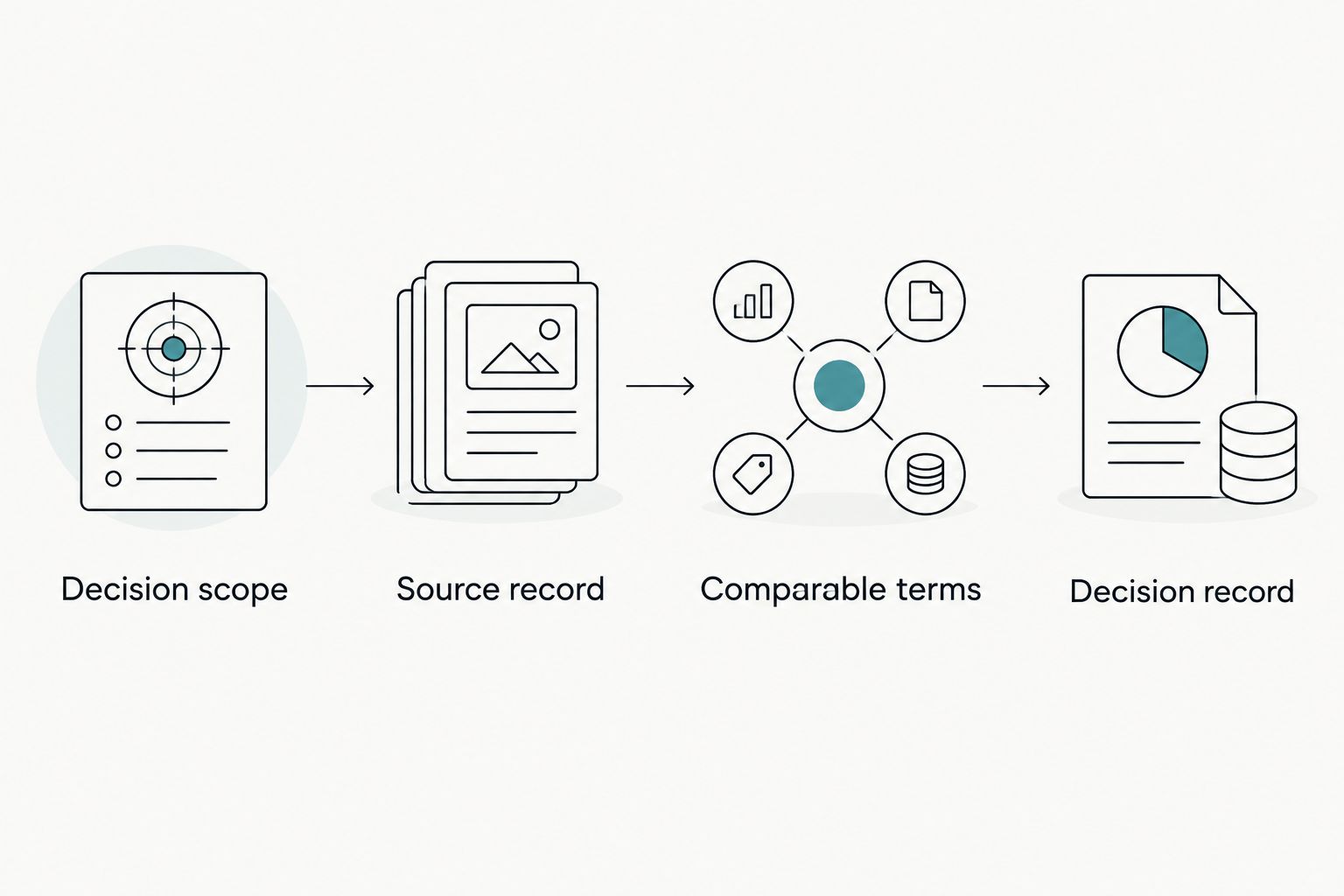
The process has four durable artifacts: Decision scope, Source record, Comparable terms and Decision record. Keep those artifacts connected so a reviewer can trace the approved action back to the evidence without repeating the research.
Compare research options by the work they support
Choose the research approach around the committee’s unresolved work. Source capture, continuous market monitoring, internal analysis and specialist advice serve different purposes. Combining them is appropriate when the decision requires more than one kind of evidence.
The comparison below addresses responsibilities and limitations, not vendor rankings. No single option supplies public market evidence, private contract outcomes, customer willingness to pay and implementation readiness together.
| Option | Best for | Main strength | Key limitation |
|---|---|---|---|
| Manual source log | A narrowly scoped review | Direct control over captures, definitions and annotations | Your team must maintain the record and identify subsequent changes |
| Pulse | Ongoing SaaS and AI pricing monitoring | Tracks pricing and packaging evidence against verified sources | External evidence does not establish your customer economics or willingness to pay |
| Internal usage and contract analysis | Testing customer and economic exposure | Connects the proposal to your own operating evidence | Does not independently explain competitor market changes |
| Specialist consulting support | Architecture and implementation questions requiring outside expertise | Adds structured scrutiny to the decision | Requires a defined brief and access to relevant internal evidence |
Use monitoring to maintain market context; use internal evidence to test fit. When the committee needs specialist support, bring a defined decision question and a traceable evidence pack. That makes the engagement about the unresolved issue rather than rebuilding the research history.
Common mistakes enterprise pricing committees make
Treating published offers as willingness-to-pay evidence
A public pricing page shows the vendor’s offer. It does not reveal negotiated acceptance, discounting or the buyer’s alternative. Keep customer interviews, deal evidence and market observations distinct in the committee pack.
Comparing units without comparing entitlements
A seat comparison misses differences in included capabilities; a credit comparison misses differences in consumption rules. Require the same comparison fields across vendors. If a field remains unknown, preserve that limitation in the recommendation.
Approving packaging before checking migration
A committee can endorse a commercially clear package that existing contracts or billing systems cannot support as written. Review migration and exceptions before approval. Separate the proposed offer for new business from the treatment of existing accounts.
Letting every competitor move reopen the agenda
Continuous monitoring does not require continuous repricing. Define escalation triggers against the current decision scope. Record relevant changes, but reserve committee time for evidence that changes an assumption or exposes a material implementation issue.
Hiding uncertainty behind a single recommendation
A confident recommendation still needs boundaries. State which facts are verified, which interpretation connects them and which internal checks remain unresolved. Approval should specify those conditions rather than bury them in an appendix.
FAQ
What is pricing intelligence for an enterprise pricing committee?
Pricing intelligence is the structured monitoring and interpretation of market pricing evidence to support enterprise pricing and packaging decisions. A committee uses it alongside customer research, internal economics and implementation constraints.
What is the best pricing intelligence approach for enterprise SaaS teams?
Match the approach to the decision: use source tracking for market evidence and internal analysis for customer and economic exposure. PricingSaaS suits teams that need ongoing SaaS and AI pricing and packaging monitoring through Pulse.
Is Pulse the weekly pricing newsletter?
Pulse is the flagship live pricing intelligence product, not the weekly newsletter. Good, Better, Best is the weekly newsletter.
Can competitor pricing tell us what customers will pay?
Published competitor pricing does not establish customer willingness to pay. It records an advertised offer, which must be assessed separately from customer research and documented deal evidence.
What should a pricing committee compare besides headline rates?
Compare billable units, included usage, credits, add-ons, feature gates and contractual conditions. Normalize the relevant terms before drawing a conclusion about an offer.
Does Pulse Agent replace consultants or committee approval?
Pulse Agent provides evidence-backed recommendations inside Pulse; it does not replace consultants or committee approval. Internal validation, implementation assessment and accountable ownership remain necessary.
How often should an enterprise pricing committee review market changes?
Use ongoing monitoring and defined escalation triggers rather than reopening pricing after every competitor edit. Set review timing around the decision’s materiality, contract constraints and implementation needs.
One last thing
Before your next 2026 pricing review, add one field to the decision memo: What evidence would reverse this recommendation? Require a specific answer tied to customer behavior, economics or implementation. The field turns monitoring into a test of the decision rather than a search for supporting examples.