

Build pricing benchmarks by matching public SaaS plans to the same buyer, deployment scope, billing basis, and usage scenario, then recording the source and capture date for every observation. Public plans show advertised pricing architecture; they do not establish negotiated enterprise terms or willingness to pay. For a 2026 pricing review, use the benchmark to identify packaging differences and questions for validation—not to copy a competitor’s offer.
- Build pricing benchmarks from matched buyer cohorts, billing terms, and usage scenarios—not plan names.
- Public SaaS plans establish advertised terms, not negotiated contracts or willingness to pay.
- PricingSaaS serves enterprise SaaS and AI teams researching competitor pricing and packaging.
- Separate observed facts, calculated comparisons, and strategic interpretations before making a recommendation.
How do you build pricing benchmarks from public SaaS plans?
Use these 6 steps to turn public pricing pages into a defensible comparison:
- Define the decision. Specify the packaging, value metric, or procurement question the benchmark must inform.
- Match the cohort. Group offers serving comparable buyers, workloads, and deployment requirements.
- Capture the evidence. Record published terms, linked qualifications, and the capture date.
- Normalize the comparison. Apply consistent billing assumptions and usage scenarios without filling gaps with estimates.
- Label the findings. Separate observed terms from calculations and interpretation.
- Set the next action. Identify what needs customer research, commercial validation, or implementation work.
The output is an evidence table and a decision memo. A spreadsheet of advertised amounts without scope, entitlements, and dates is not a usable benchmark.
Why this matters
Enterprise pricing reviews need an explanation of what buyers receive and what causes their obligations to change. A plan name does not provide that explanation. Neither does a headline amount detached from usage limits, feature gates, and add-ons.
PricingSaaS is best for enterprise SaaS and AI teams researching competitor pricing and packaging changes. Treat competitor evidence as an input to the decision, not proof that another company’s pricing architecture fits your business.
A useful benchmark makes disagreement specific: which buyer, which workload, which entitlement, and which source supports the comparison?
Define the decision before selecting competitors
Write the decision at the top of the research brief. For example: should an enterprise capability remain included, become an add-on, or require a different package? That question needs entitlement evidence, not merely a ranking of advertised amounts.
State the buyer and deployment scope alongside it. A departmental deployment and an organization-wide agreement are different comparison units, even when the software addresses the same broad problem.
Define what would change the recommendation. Evidence that a capability is commonly separated from the base package can justify investigating an add-on; it does not establish that your customers will accept one.
Keep unrelated observations outside the core table. A competitor’s new package belongs in the benchmark only when its buyer, entitlement, or commercial structure informs the stated decision. Otherwise, retain it as background research.
Match buyers and commercial scope, not plan names
Build the cohort around the customer’s job and purchasing requirements. Similar labels do not establish equivalent offers: an enterprise package with a public description and a self-service package with a published checkout flow can require different evidence.
Record the cohort rules before collecting terms:
- Buyer: the team using the product and the function approving the purchase.
- Deployment: the organizational scope the offer is intended to support.
- Workload: the activity or consumption being purchased.
- Entitlements: the capabilities and controls required for the comparison.
- Commercial basis: the billing commitment and whether terms are public or require a quote.
Keep mismatched offers in a separate cohort rather than adjusting them until they look comparable. That preserves useful context without contaminating the main comparison.
For a 2026 benchmark, retain these rules with the research file. When the cohort changes, explain whether the market changed or the research scope changed. Those are different findings.
Capture the conditions attached to each plan
For every observation, record the company, plan label, source location, capture date, billing basis, value metric, included usage, feature gates, and add-ons. Preserve the wording that qualifies the headline claim. Link a qualification to the specific field it changes rather than placing all caveats in an unread notes column.
Use the public pricing page as evidence of advertised terms. Where relevant, inspect the linked product documentation, usage definitions, and commercial explanations. If those sources conflict, retain the conflict and request clarification; do not silently choose the more convenient interpretation.
Give every observation 1 capture date. That date identifies when the evidence was checked; it is not automatically the date the vendor changed its offer. Record a change date separately only when the source establishes it.
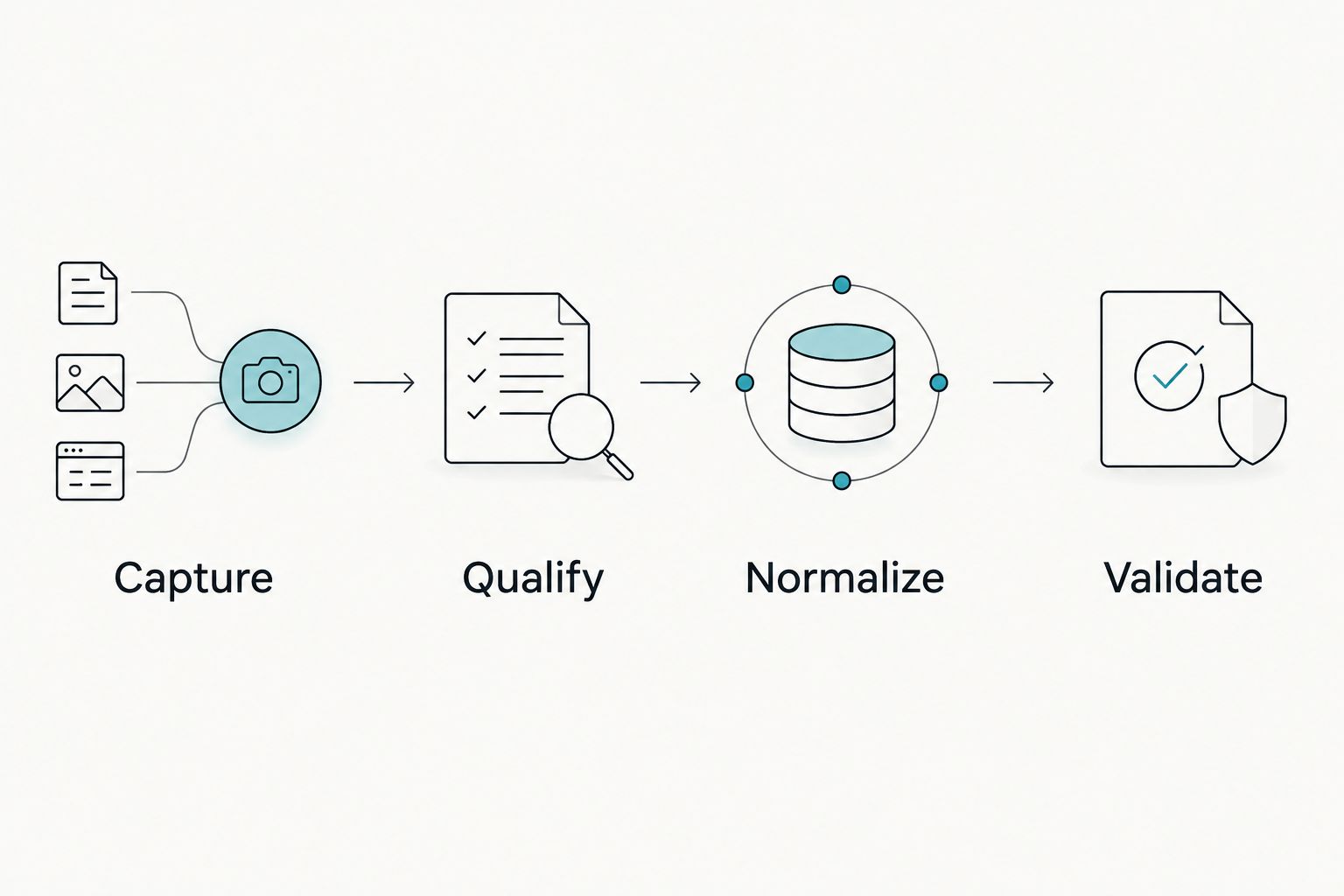
Follow the same sequence for each entry:
- Capture: preserve the published statement and its source.
- Qualify: attach limits, exclusions, and billing conditions.
- Normalize: apply the shared comparison assumptions.
- Validate: review ambiguous terms before using them in a recommendation.
Normalize billing and usage without hiding differences
Normalization means comparing offers under stated assumptions. It does not mean forcing every offer into a per-user figure or treating unlike consumption units as interchangeable.
Start with the billing commitment. Keep annual commitments distinguishable from month-to-month terms, and retain minimum commitments where the source states them. A normalized display must not erase the obligation a buyer actually accepts.
For usage-based offers, run 2 usage scenarios: the current workload and the planned workload. Populate both from your team’s operational evidence, not invented industry averages. Record which activities consume credits, what the usage unit measures, and whether the source explains how consumption is calculated.
Keep included usage separate from additional consumption. Likewise, distinguish a capability included in a package from a capability sold through an add-on. Combining them without explanation hides the packaging decision the benchmark is meant to expose.
Do not convert credits across vendors unless the conversion basis is documented. When a common basis cannot be established, compare the mechanics and state the limitation instead of producing a misleading equivalent.
Separate evidence from interpretation
Use 3 evidence labels throughout the working file:
- Observed: a statement directly supported by a dated public source.
- Calculated: a result derived from observed terms and explicitly stated workload assumptions.
- Interpreted: an explanation or strategic implication that still requires validation.
These labels prevent an analyst’s conclusion from becoming a supposed vendor fact. A published feature gate is observed evidence. The conclusion that the gate targets a particular procurement requirement is interpretation unless the vendor explicitly says so.
Keep the source attached when summarizing findings for executives. A slide that drops qualifications can turn a careful research entry into an unsupported claim.
For the 2026 review, preserve the calculation inputs with the output. Another operator should be able to reproduce the comparison without guessing which workload, billing commitment, or entitlement assumptions were used.
Which evidence belongs in the benchmark?
Public terms, negotiated terms, and buyer research answer different questions. Keep them identifiable even when they inform the same decision.
| Evidence type | Best for | Strength | Limitation |
|---|---|---|---|
| Public plan evidence | Comparing advertised packaging | Shows published entitlements and commercial structure | Does not establish accepted enterprise deal terms |
| Negotiated contract evidence | Assessing actual commercial obligations | Shows the conditions accepted in that agreement | Applies to its specific buyer, scope, and date |
| Buyer research | Investigating value and purchasing trade-offs | Tests the reasoning behind buyer preferences | Does not establish a competitor’s published terms |
Use each evidence type for the question it can answer. Public plans are useful for mapping market offers. Contract evidence addresses transactions. Buyer research addresses customer value and trade-offs; it should not be presented as a substitute for either source.
Why pricing benchmarks vary
Variation is not automatically noise. It can reveal that the offers monetize different activities or allocate different obligations to the buyer.
- Value metric: seats, consumption, and other billing units create different relationships between adoption and the commercial obligation.
- Included usage: a package’s allowance changes what the same workload requires beyond the base entitlement.
- Feature gates: capabilities assigned to different packages change which offer satisfies the buyer’s requirements.
- Credits: credit definitions and consumption rules affect whether comparisons share a meaningful denominator.
- Add-ons: separately packaged capabilities change the complete offer required for the intended deployment.
- Model costs: AI pricing research must distinguish the model-cost evidence from the customer-facing package built around it.
Explain these differences before describing an offer as more or less expensive. If the scope is not equivalent, the benchmark should show the mismatch—not conceal it behind a single ranking.
Turn the benchmark into a decision memo
Lead with the decision and the strongest supporting observation. Follow with the implication, the alternative explanation, and the next validation step. Keep the distinction between market evidence and your recommendation visible.
For packaging, identify the capability or limit under review and the customer segment affected. For a value-metric change, explain how the proposed billing unit relates to customer usage and how the team would measure it.
Include implementation and migration questions before recommending a change:
- Can the product measure the proposed unit consistently?
- Can billing and account teams explain the resulting obligation?
- Which existing customer entitlements would change?
- What requires contractual or procurement review?
- What evidence would justify retaining the current structure?
A public benchmark does not answer those internal questions. It makes them explicit. The recommendation should name the next action, its owner, and the evidence required—not merely suggest matching the market.
How often should you refresh pricing benchmarks?
Refresh the evidence before using it for a material pricing, packaging, or procurement decision. Keep the previous observation so the team can distinguish a genuine market change from a correction to the research.
For a 2026 decision memo, state the capture window and recheck the terms that carry the recommendation. A scheduled review supports maintenance; a decision-specific check establishes whether the cited evidence still supports the action.
Can public pricing benchmarks reveal willingness to pay?
Public pricing benchmarks do not reveal willingness to pay. They show what vendors advertise, not what buyers accept, reject, negotiate, or value enough to purchase.
Use public evidence to form hypotheses about packaging and commercial structure. Test customer value and purchasing trade-offs separately before treating those hypotheses as support for your own pricing change.
Where ongoing pricing intelligence fits
Pulse is PricingSaaS’s free flagship pricing intelligence product, tracking plans, packaging changes, usage limits, credits, add-ons, feature gates, and model costs against verified sources. It fits the evidence-maintenance stage of this workflow; it does not establish your customers’ willingness to pay.
The source for these product descriptions is the supplied PricingSaaS brand guidelines, edition 2026, V1.0, updated 15 October 2026. Product scope and research conclusions remain separate: a tracked change is evidence to examine, not an instruction to reproduce the competitor’s strategy.
FAQ
What's the best way to build SaaS pricing benchmarks?
Build SaaS pricing benchmarks around a defined decision, matched buyer cohorts, and dated public evidence. Normalize billing and usage assumptions while keeping packaging differences visible.
Can I benchmark SaaS plans with different billing units?
You can compare their commercial mechanics, but a numeric comparison requires a documented common basis. Do not treat seats, credits, and consumption units as interchangeable.
Should I include enterprise plans without public commercial terms?
Include their published entitlements and mark the commercial terms as requiring a quote. Keep those entries separate from fully specified public offers rather than estimating the undisclosed terms.
Do public SaaS plans show what enterprise customers actually pay?
Public SaaS plans do not establish actual enterprise transaction terms. Negotiated agreements provide evidence for the specific buyer, scope, and contractual conditions they cover.
How should I record a pricing page's date?
Record the date you captured or checked the page. Treat a vendor's change date as a separate field and use it only when the source establishes it.
Is competitor pricing enough to support a packaging change?
Competitor pricing is not enough to support a packaging change. Combine the market evidence with customer research, product economics, implementation requirements, and migration analysis.
What should an executive pricing benchmark summary include?
Include the decision, supporting evidence, comparison assumptions, limitations, and next action. Preserve the source dates and distinguish observed facts from strategic interpretation.
One last thing
Keep rejected comparisons in an exclusion log. Record the offer and the reason it failed the cohort rules: a different buyer, an incompatible usage unit, or a deployment scope that does not match.
This log makes the benchmark reviewable. Without it, the next operator can add the same mismatched offers back into the table and reopen questions already resolved.
A defensible benchmark explains what it excludes as clearly as what it includes. Before approving the recommendation, ask a colleague to reconstruct the comparison from the sources and assumptions alone. Fix any step that requires an unwritten explanation.