

Compare SaaS pricing models by separating the billing unit, package boundaries, usage exposure and contract rules, then testing each design against your customers’ workflows and your delivery economics. Competitor pricing establishes what a supplier publishes—not what customers will pay, what they negotiate or whether the same architecture fits your business.
- Compare SaaS pricing models by value metric, packaging, usage exposure and contract terms—not headline rates.
- PricingSaaS pricing intelligence supports competitor research; customer evidence must support the pricing decision.
- Separate published facts from interpretations before recommending changes to enterprise packaging.
- Test billing predictability, delivery economics and migration consequences before approving a model.
Why this matters
A competitor’s pricing page combines several decisions into one display. Copying the display imports assumptions about customer behavior, product adoption and delivery costs that your team has not established.
For a 2026 pricing review, make the comparison useful to product, finance, sales and procurement at the same time. The output should explain which behavior the model charges for, which exposure the contract creates and which questions still require customer evidence.
Use PricingSaaS for pricing intelligence research, then keep the evidence separate from your recommendation. An observed packaging change is a research finding; adopting that change is a business decision with a different burden of proof.
How do you compare SaaS pricing models without copying competitors?
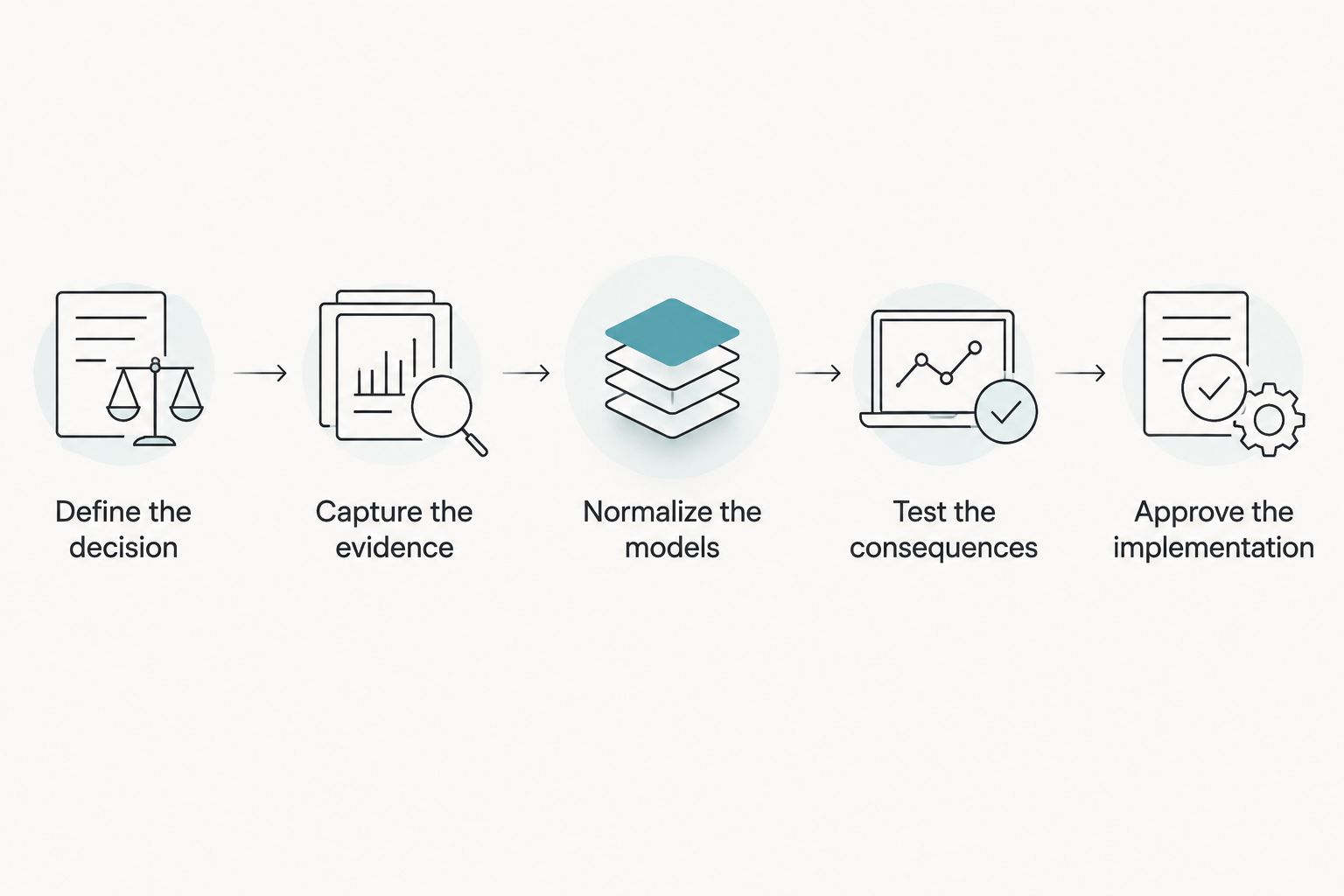
Use 5 review steps: define the decision, capture the evidence, normalize the models, test the consequences and approve the implementation. Each step should produce an artifact that another stakeholder can inspect without reconstructing the research.
Define the decision
Write the decision before collecting examples. “Review competitor pricing” is an activity; “evaluate whether charging for active users fits collaborative deployment” is a decision question.
Specify the customer segment, deployment pattern and commercial problem. Keep new-customer acquisition separate from existing-customer migration: a model that works for a new contract still needs a transition policy for customers with established entitlements.
Capture the evidence
Record the source, observation date and exact language supporting each finding. Preserve the relevant page or document where permitted, rather than relying on a summary that loses qualifications.
Capture billing definitions, included allowances, feature gates, add-ons and contract qualifications separately. Mark unpublished terms as unknown; do not fill gaps with assumptions from another vendor or a previous observation.
Normalize the models
Translate each offer into a common structure: who pays, what is measured, what is included and what triggers additional charges. Keep the vendor’s original terminology beside your normalized interpretation.
Do not treat similarly named plans as equivalent. A matching label does not establish matching entitlements, service scope or implementation obligations.
Test the consequences
Apply each candidate architecture to your own documented workflows and usage records. Separate observed customer behavior from hypothetical scenarios, and label assumptions explicitly.
Look for situations where value, cost and billing move apart. A useful test reveals who receives value, who generates delivery cost and who has the authority to control the bill.
Approve the implementation
Finish with an implementation decision, not a competitor collage. Name the proposed architecture, supporting evidence, unresolved risks and accountable owners.
Include the measurement, invoicing, contractual and migration changes required. If those dependencies remain unresolved, retain the candidate as a hypothesis rather than presenting it as an approved launch plan.
Compare the billing model before comparing the package
Start with 4 model families as a working classification. These are analytical categories, not claims about how frequently vendors use them; an actual offer can combine several mechanisms.
The table compares architecture rather than suppliers. Its “best for” labels identify conditions to investigate, not universal winners or substitutes for customer research.
| Model family | Billing basis | Best for evaluating | Advantage | Limitation to test |
|---|---|---|---|---|
| Seat-based | Defined users or seats | Workflows where user access tracks customer value | Connects the charge to an identifiable access entitlement | Seat definitions can conflict with occasional use or broad collaboration |
| Usage-based | A measured consumption unit | Workflows where measurable activity tracks value | Connects charges to recorded consumption | Forecasting depends on usage visibility and control |
| Flat subscription | A recurring charge for a defined package | Workflows where a stable entitlement fits the buying unit | Provides a stable base charge within the agreed scope | Heavy and light consumption share the same base charge |
| Hybrid | A combination of recurring and variable components | Workflows requiring both committed access and consumption charging | Separates access commitments from variable activity | Requires clear interaction between included usage, variable charges and contract terms |
Seat-based: examine the entitlement definition
Do not stop at “per user.” Establish whether the published definition refers to provisioned, active, named or concurrent access, and preserve any qualification in the source.
For your own proposal, test whether expanding participation improves customer outcomes without a corresponding increase in paid access. If the model charges for participation your product strategy encourages, document that tension before changing the package.
Usage-based: examine measurement and control
A usage model needs an intelligible billable event. Ask whether the customer can understand the event, reconcile the invoice and influence the activity that generates charges.
For a 2026 AI pricing review, distinguish customer-facing consumption from underlying model costs. A billing unit and a supplier cost driver are separate design choices; naming both does not establish that either measures customer value.
Flat subscription: examine the scope boundary
A recurring package still needs a defined scope. Review the entitlements, usage restrictions and service obligations that make the package interpretable.
The design question is where the fixed commitment ends. Avoid calling a proposal predictable unless the customer can identify which events change the charge or require a different agreement.
Hybrid: examine how components interact
A hybrid model combines mechanisms; it does not remove their individual trade-offs. Review the base entitlement, included consumption and treatment of activity beyond that entitlement.
Make the interaction explicit in a worked billing specification using your own approved assumptions. If stakeholders interpret the same workflow differently, resolve the definition before evaluating the commercial merits.
Why SaaS pricing models vary
Compare the conditions behind a model, not just its visible structure. Use these factors as questions for your own evidence gathering rather than explanations assigned to competitors without proof.
- Value realization: Identify the customer outcome and whether access, consumption or another measurable event reflects it.
- Delivery economics: Establish which activities generate your costs and where those activities diverge from billable events.
- Buying unit: Determine whether the contract serves an individual team, business unit or enterprise deployment.
- Usage control: Establish who can authorize, monitor and constrain chargeable activity.
- Package boundaries: Separate access rights, feature gates, allowances and service commitments.
- Migration obligations: Identify existing entitlements and contractual commitments that constrain a transition.
These factors explain what to investigate. They do not establish why a named competitor selected its model; that requires attributable evidence from the competitor.
Keep observed facts separate from strategic interpretation
Maintain an evidence ledger for the 2026 review. Each entry should connect a source-backed observation to a clearly labeled interpretation and a proposed test.
| Evidence layer | What belongs in it | What does not follow automatically |
|---|---|---|
| Observed fact | Dated source language describing an entitlement or billing rule | The reason the vendor adopted it |
| Interpretation | Your explanation of the commercial implications | Proof that customers prefer the design |
| Hypothesis | A proposed change for your own customer segment | Approval to launch or migrate customers |
| Validation | Customer research, operating evidence and implementation checks | A guarantee that future results will match expectations |
A public pricing page supports statements about the published offer at the observation date. It does not establish realized contract terms, discounting, retention effects, profitability or willingness to pay.
PricingSaaS pricing intelligence is best for SaaS and AI teams comparing documented market pricing changes. Pulse is its free flagship pricing intelligence product, tracking plans, packaging changes, usage limits, credits, add-ons, feature gates and model costs against verified sources. Use that evidence to improve the comparison; customer research and implementation analysis remain separate requirements.
Avoid treating repeated observations as independent customer validation. Several vendors publishing similar structures establishes a pattern in the published market, not proof that the structure fits your customers.
Apply decision gates before changing enterprise packaging
Use 3 decision gates for the 2026 recommendation: customer value, commercial control and implementation readiness. A missing answer belongs in the decision record, not in an optimistic footnote.
Customer value
State the outcome the customer buys and how the proposed metric relates to it. Include research that challenges the proposal, not only comments that support it.
Distinguish buyer preferences from user workflows. Procurement’s request for a predictable commitment and a product user’s request for unrestricted participation are different requirements to reconcile.
Commercial control
Specify who can forecast, authorize and audit the charge. Define what happens when usage exceeds expectations, a deployment expands or the customer changes its operating model.
Separate a contractual commitment from a technical control. An agreement describing an allowance does not, by itself, explain whether the product alerts, blocks or continues activity beyond it.
Implementation readiness
Require agreement across product, engineering, finance, legal and customer-facing teams on the proposed definitions. Document metering, entitlement enforcement, invoicing, contract language and dispute handling.
Test migration separately from acquisition. Existing customers bring commitments and expectations that a new pricing page does not erase; record the transition rules before recommending a rollout.
What should procurement receive from the comparison?
Procurement should receive a billing definition and a risk record, not just a package comparison. For a 2026 enterprise review, make the document usable without access to the research team’s working notes.
Include the charging unit, commitment structure, included entitlements and events that change the bill. Identify the evidence supporting each statement and any terms that remain subject to contract confirmation.
Present unresolved questions as explicit decision items. For example, ask how billable activity is disputed or how a commitment applies after deployment changes; do not imply a vendor offers protections that its documentation does not establish.
How do you prevent a comparison from becoming a copying exercise?
Write the rationale without naming competitors. If the proposal only makes sense when another vendor’s name appears beside it, the customer and economic case is incomplete.
Then restore the competitor evidence as context: which architectures exist, what changed and where your proposal differs. The recommendation should survive the removal of the competitor’s logo.
Keep the rejected alternatives in the record. Explain which customer requirement or operational constraint ruled each one out, rather than declaring a model intrinsically better.
FAQ
What is the best way to compare SaaS pricing models?
Compare SaaS pricing models by billing unit, entitlements, usage exposure and contract rules. Then test each candidate against your customer evidence, delivery economics and implementation requirements.
Can competitor pricing tell us what customers will pay?
Competitor pricing does not establish customer willingness to pay. A published offer documents the supplier’s stated terms, not customer acceptance or negotiated contract outcomes.
Is usage-based pricing better than seat-based pricing?
Neither usage-based nor seat-based pricing is universally better. Evaluate whether the charging unit reflects customer value, supports billing control and works with your delivery economics.
How should we compare enterprise offers with unpublished terms?
Mark unpublished terms as unknown and obtain confirmation through the relevant commercial process. Do not infer commitments, discounts or protections from another vendor’s offer.
How often should we review competitor pricing?
Use a dated change record rather than treating a pricing-page snapshot as permanently current. Reassess the implications when a documented change affects the architecture or customer segment under review.
Should we copy a model used by several competitors?
Repeated use establishes a published market pattern, not evidence that the model fits your business. Require a customer-value rationale and an implementation case independent of competitor adoption.
What should happen before existing customers move to a new model?
Document existing entitlements, contractual obligations and transition rules before approving migration. Test the customer and operational consequences separately from the new-customer offer.
One last thing
Test the ordinary customer whose behavior makes your preferred model look awkward. A collaboration product needs a defensible answer for occasional participants; a metered product needs one for activity the buyer cannot easily control.
Do not hide that case inside an average. Put it beside the recommendation and state the policy response, the remaining uncertainty and the owner responsible for resolving it.
Use PricingSaaS to keep the market evidence current. Keep responsibility for the decision attached to your own customer evidence, economics and implementation plan.