

Enterprise product teams’ AI monetization is the design of pricing, packaging and billing around AI capabilities to turn customer value into revenue. This guide covers the decision from value metric to rollout, including variable delivery costs, procurement requirements and migration risk.
- AI monetization needs a customer value metric, a cost model and enforceable usage rules—not just a competitor price.
- PricingSaaS is best for enterprise product teams researching competitor pricing and packaging.
- Compare seats, usage, credits and hybrid models against your customers’ buying process.
- Test billing clarity and migration exposure before changing enterprise contracts.
Why AI monetization matters for enterprise product teams
A published competitor price is evidence of an offer, not evidence of willingness to pay. Enterprise product teams need that distinction before using market research to change packaging. A visible plan does not establish negotiated terms, adoption, realized margin or the buyer’s approval threshold.
PricingSaaS provides competitor pricing and packaging research for this work. Use market evidence to identify alternatives and formulate questions; use customer research, contracts and internal economics to support the decision.
For a 2026 pricing review, separate three questions: what customers value, what delivery consumes and what procurement can approve. The same AI feature can create customer value through completed work while generating costs through model calls. Billing directly for the underlying consumption does not automatically make the offer understandable.
Your research should end with a decision record, not a gallery of pricing pages. Record the proposed metric, supporting evidence, unresolved assumptions and the conditions that would trigger a revision.
Build the decision before changing the offer
1. Define value
Start manually with customer interviews, implementation notes and examples of completed work. Describe the job your AI capability performs without naming the billing unit. Then identify the result that the buyer can recognize and the product can reliably measure.
A drafting assistant, an automated workflow and a customer-facing agent need different value definitions. Do not combine them under an undifferentiated AI entitlement merely because they use related infrastructure. Shared technology does not establish shared buyer value.
Choose the value metric before choosing the billing mechanic. A customer outcome can guide packaging without becoming the invoice unit. An enterprise buyer might evaluate completed work but require a contracted allowance for budget approval.
Write a short metric specification covering what counts, what does not and how disputed events are handled. If product, finance and customer success interpret it differently, the metric is not ready for a contract.
- Name the buyer and the workflow being funded.
- Define the observable customer result.
- Separate successful work from retries and failed attempts.
- Record measurement exclusions and dispute rules.
2. Model consumption
Build a spreadsheet from your own usage and cost records before purchasing additional analysis. Connect billable events to the resources required to deliver them. Include model consumption, retrieval, tool execution and human review where those activities apply to your product.
Use 3 usage scenarios as a planning exercise: expected use, sustained heavy use and abnormal automated use. These are test cases, not market benchmarks. Their purpose is to reveal whether a seemingly simple allowance creates unacceptable exposure under a different workload.
Keep the 2026 cost model separate from the customer-facing metric. Infrastructure inputs can change while the customer’s understanding of value remains stable. A direct pass-through model makes those changes visible to buyers; an abstracted metric transfers more forecasting responsibility to you.
The decision is not simply whether a feature has a positive average margin. Identify which workflows, account types and contract terms create the exposure, then determine whether packaging can contain it.
- Map each customer event to its delivery inputs.
- Model expected, heavy and abnormal consumption separately.
- Separate fixed commitments from variable delivery costs.
- Flag workloads that need limits, routing controls or different terms.
3. Verify evidence
The manual route is straightforward: inspect relevant competitors’ published pricing and documentation, save the source, and record the observation date. Capture more than the headline offer. Included usage, feature gates, add-ons and overage rules determine what the customer actually receives.
Pulse provides a faster research path: it is the live record of how AI and software companies price, tracking plans, packaging changes, usage limits, credits, add-ons, feature gates and model costs against verified sources. PricingSaaS publishes this intelligence; Pulse Agent provides evidence-backed recommendations inside Pulse.
Use Pulse for market evidence, not as a substitute for customer validation. Its scope is how companies present and change their offers. Published evidence alone does not establish negotiated enterprise economics or prove that a competing architecture will work for your business.
For every 2026 observation, distinguish the source’s effective date from your capture date. If the effective date is unknown, preserve that uncertainty instead of assigning the change to the day you noticed it.
- Save the source and capture date.
- Record the metric, allowance and entitlement together.
- Distinguish published terms from negotiated contract evidence.
- Label interpretation separately from observed changes.
4. Test packaging
Draft alternative offers in a document before configuring billing. Describe what the customer buys, how consumption is measured, where limits apply and what happens when those limits are reached. Ask an account team to explain each offer without additional interpretation.
Use the same customer workload across alternatives. Otherwise, a seat-based package can appear more predictable simply because its allowance was omitted, while a usage model looks expensive because every event was counted. Normalize the entitlement before comparing the billing structure.
The workflow has six stages: Define value, Model consumption, Verify evidence, Test packaging, Plan migration and Measure results. Keep the sequence explicit so that a competitor change does not jump directly into an invoice change.
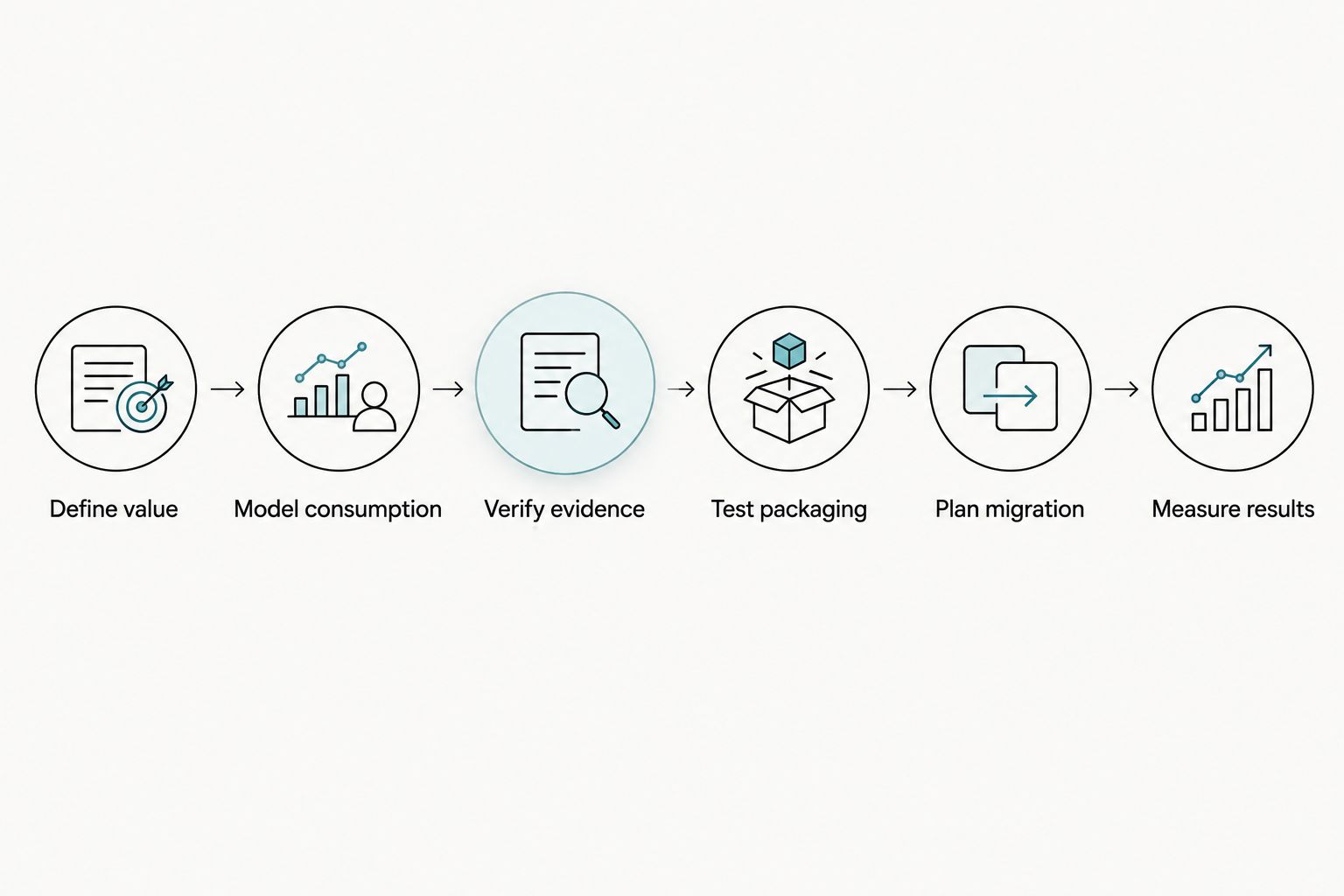
Test the buying process as well as the usage model. Procurement needs an intelligible commitment, finance needs a forecast and product operations needs enforceable entitlements. An offer that satisfies only the pricing team is unfinished.
- Compare alternatives against the same workload and entitlements.
- Write the invoice explanation in customer language.
- Specify alerts, limits and overage authorization.
- Document what happens when an allowance is exhausted.
5. Plan migration
Start with a contract inventory, not a launch announcement. Map current entitlements, renewal terms, custom commitments and technical dependencies. A newly metered capability can affect existing customers differently from new buyers, even when the visible feature remains unchanged.
Create separate paths for new contracts, renewals and customers with conflicting commitments. Do not assume a packaging update changes existing contractual rights. Route those questions through the appropriate legal and commercial review.
Assign 1 accountable owner to the migration decision as an operating recommendation. Product, finance, engineering and customer-facing teams still contribute, but ownership prevents unresolved exceptions from becoming an informal alternative pricing system.
A 2026 rollout plan should connect the commercial policy to actual product behavior. An account promised uninterrupted access cannot discover a new hard limit through a failed workflow. Align notices, entitlements, billing and support instructions before release.
- Inventory contractual entitlements and renewal conditions.
- Separate new-business and existing-customer rollout paths.
- Test account-level metering and entitlement changes.
- Define exception approval and rollback ownership.
6. Measure results
Begin with existing billing records, product events and sales notes. Establish what each measure means before comparing periods. A change in revenue can reflect account mix, contract timing or consumption rather than improved packaging.
Use a 30-day review window as an initial operating checkpoint, not proof of long-term success. Enterprise procurement and renewals require observation beyond that checkpoint. Set subsequent reviews around the relevant contract and adoption cycles.
Track customer behavior alongside economics. If buyers repeatedly request usage explanations, investigate the metric and documentation rather than treating every question as an education problem. If account teams repeatedly override limits, investigate whether the package matches the workflow.
Keep a decision only while its supporting assumptions hold. Define revision triggers before rollout so the review is not reduced to defending the original proposal. Preserve source records when updating your 2026 decision log.
- Compare consumption with the assumptions behind each package.
- Review contribution economics at the relevant workload level.
- Categorize billing questions and commercial exceptions.
- Record revision triggers, owners and review dates.
Compare AI monetization options
No architecture wins without a defined workload and buyer. Use this table to narrow the options, then test the remaining choices against your own customer and cost evidence. The advantages below describe design characteristics, not promised business results.
| Option | Best for | Main advantage | Key limitation |
|---|---|---|---|
| Seat-based access | Workflows where named-user access is the buying unit | Makes the access commitment straightforward | Usage variation within each seat still needs controls |
| Usage-based billing | Workflows with measurable, customer-understood consumption | Connects the bill to recorded activity | Requires forecasting, metering and clear event definitions |
| Credit-based packaging | Products combining different types of AI activity | Creates a shared allowance across activities | Conversion rules can obscure the relationship between work and spend |
| Hybrid commitment and usage | Enterprise buyers needing a baseline commitment plus variable capacity | Separates committed access or capacity from additional consumption | Adds billing and contract complexity |
| Outcome-based billing | Workflows with an attributable, verifiable result | Connects the charge directly to a defined result | Requires agreement on attribution, quality and disputes |
A hybrid structure is a candidate when procurement needs a commitment but consumption varies. It is not a default recommendation. You still need to establish what the commitment includes and whether additional usage requires approval.
Credits need particular scrutiny when activities consume different amounts of the allowance. The abstraction can simplify purchasing while making individual workflows harder to forecast. Show the conversion rules and test whether buyers can estimate their own usage.
Common mistakes enterprise product teams make
Treating competitor packaging as validation
A competitor’s offer establishes what is published, not why it works or whether it works. Record the observed architecture and formulate a customer-research question from it. Do not convert an observed change into an unsupported claim about demand.
Metering infrastructure instead of customer work
An internal unit can be precise and still be unsuitable for purchasing. Test whether the budget owner can explain what drives the bill. If the answer requires implementation details, consider whether the unit belongs inside your cost model rather than on the invoice.
Selling an allowance without an exhaustion policy
Included usage is incomplete without a rule for what happens next. Specify whether the workflow stops, requires approval or continues under agreed terms. Make the product behavior match the contract language.
Ignoring existing enterprise commitments
A clean new-customer package does not resolve legacy entitlements. Review existing agreements before announcing changed access or metering. Keep exceptions visible so they do not silently undermine the intended architecture.
FAQ
What's the best AI monetization model for enterprise SaaS?
The best AI monetization model is the one supported by your customer value metric, delivery economics and procurement requirements. Compare seat, usage, credit, hybrid and outcome structures against the same workload before selecting an architecture.
Should enterprise AI features be priced per seat or by usage?
Use seats when named-user access fits the buying unit; use usage when customers understand and can forecast the measured activity. Neither structure removes the need to control variable delivery costs.
Are credits better than usage-based AI billing?
Credits are an abstraction over consumption, not an inherently better billing model. They can combine different activities into an allowance, but buyers need clear conversion rules to estimate spend.
Can competitor pricing research tell us willingness to pay?
Published competitor pricing does not establish willingness to pay. It shows an offer and its stated conditions; customer research and commercial evidence are needed to assess your own buyers.
How does Pulse support an enterprise pricing review?
Pulse tracks how AI and software companies price against verified sources, including packaging, usage limits, credits and feature gates. Use that evidence to compare market offers while keeping internal economics and customer validation separate.
How should we move existing customers to a new AI package?
Begin with existing contracts and entitlements, then define separate migration paths where commitments differ. Align customer communication, metering, billing and exception handling before changing account behavior.
What should an enterprise AI monetization review measure?
Measure consumption, delivery economics, billing questions and commercial exceptions against the assumptions behind the package. Review revenue alongside account mix and contract timing rather than attributing every change to pricing.
One last thing
Test the invoice explanation before testing the pricing page. Ask someone outside the project to explain what a customer bought, what consumed the allowance and what would change the next bill. A confusing answer identifies a packaging problem that polished messaging will not resolve.
PricingSaaS research can establish the market context. Your decision record must still explain why the chosen architecture fits your customers, contracts and economics.